[postgres] starting...
[postgres] OK
[maven] starting...
[maven] OK
[diag] 1/5 classpath du kernel exposée
[diag] 2/5 imports slf4j/logback OK
[diag] 3/5 contexte logback OK
[diag] 4/5 %jars OK
[diag] Postgres driver registered OK
[diag] 5/5 imports JPA/DatabaseManager OK
17:20:43.587 [IJava-executor-0] INFO  f.u.b.d.jpa.hello.DatabaseManager -- Database settings: URL=jdbc:postgresql://dind/notebook-db, User=dba
17:20:43.595 [IJava-executor-0] INFO  f.u.b.d.jpa.hello.DatabaseManager -- Starting JPA with URL: jdbc:postgresql://dind/notebook-db and User: dba
17:20:44.794 [IJava-executor-0] INFO  com.zaxxer.hikari.HikariDataSource -- HikariPool-1 - Starting...
17:20:45.039 [IJava-executor-0] INFO  com.zaxxer.hikari.pool.HikariPool -- HikariPool-1 - Added connection org.postgresql.jdbc.PgConnection@23aa2f2d
17:20:45.041 [IJava-executor-0] INFO  com.zaxxer.hikari.HikariDataSource -- HikariPool-1 - Start completed.
--> Connexion JPA réussie (Tentative 1) !
[diag] cell init terminée ✓Les associations entre entités avec JPA
Contrôles des relations entre entités avec JPA.
2026-10-14
One To One (1-1)
- 1-1 en Java mais une seule relation
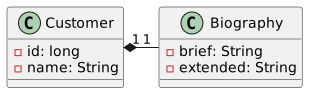
```xbayay execute: false //| output: true //| echo: false //| label: fig-rel-onetoone //| fig-cap: L’unique relation CUSTOMER //| vscode: {languageId: java} // PRINT SCHEMA String script=“%”;
IJava.getKernelInstance().getMagics().applyCellMagic(“rdbmsSchema”, List.of(“ex_biography”),script); return null;
:::
::::

::: {.content-visible when-profile="notes"}
Pour cela JPA propose des annotations spécifiques :

[\@Embeddable](https://jakarta.ee/specifications/persistence/3.1/apidocs/jakarta.persistence/jakarta/persistence/embeddable): Cette annotation indique que les membres d'une classe Java peuvent être persistés en tant qu'attributs de la classe qui les utilise. En d'autres termes, elle spécifie qu'une classe peut être utilisée comme composant réutilisable dont les propriétés peuvent être incorporées dans une autre entité.

[\@Embedded](https://jakarta.ee/specifications/persistence/3.1/apidocs/jakarta.persistence/jakarta/persistence/embedded): Utilisée au niveau d'un membre de classe annoté avec \@Embeddable, cette annotation indique que le membre annoté doit être intégré dans la relation. Cela signifie que les propriétés de la classe annotée avec \@Embeddable seront incluses dans la table de la classe qui les utilise.
:::


::: {.content-visible when-profile="slides"}
- Pour cela, JPA propose :
    - [\@Embeddable](https://jakarta.ee/specifications/persistence/3.1/apidocs/jakarta.persistence/jakarta/persistence/embeddable): Indique que les membres d'une classe peuvent être persistés en tant qu'attributs de la classe qui les utilise.
    - [\@Embedded](https://jakarta.ee/specifications/persistence/3.1/apidocs/jakarta.persistence/jakarta/persistence/embedded): Utilisé avec `@Embeddable` pour intégrer ses propriétés dans une autre entité
:::

::: {.content-visible when-profile="slides"}
## Un client a une et une seule biographie {.smaller}
:::

:::: {.columns}

::: {.column width="50%"}

::: {#cell-fig-class-embeddable .cell filename='null' quarto-private-1='{"key":"vscode","value":{"languageId":"java"}}' execution_count=4}

::: {#fig-class-embeddable .cell-output .cell-output-display .cell-output-markdown}
```Java
@Builder
@NoArgsConstructor(access = AccessLevel.PROTECTED)
@AllArgsConstructor

@Embeddable
public class Biography {
    @Column(name = "BIO_BRIEF")
    private String brief;

    @Lob
    @Column(name = "BIO_EXTENDED")
    private String extended;
}
Embeddable.java
:::
@Getter
@Setter
@ToString
@RequiredArgsConstructor(staticName = "of")
@NoArgsConstructor(access = AccessLevel.PROTECTED)

@Entity
@Table(name = "CUSTOMER", schema = "ex_biography")
public class Customer {
    @Id
    @GeneratedValue
    private long id;

    @Column(length = 50, nullable = false)
    @NonNull
    private String name;

    @Embedded
    @Column()
    private Biography biography;
}
Customer.java
::::
One to Many (1-N)
Figure 3: Une Order a plusieurs Line
@Getter
@Setter
@ToString
@NoArgsConstructor
@Builder
@AllArgsConstructor

@Entity
@Table(name = "EORDER", schema = "EX_ONE_TO_MANY_B")
public class Order {
    @Id
    @GeneratedValue(strategy = GenerationType.SEQUENCE)
    private long id;

    @Builder.Default
    @Column(nullable = false)
    private LocalDateTime date = LocalDateTime.now();

    @ElementCollection
    @CollectionTable(name = "LINE", schema = "EX_ONE_TO_MANY_B")
    @Singular
    private Set<Line> lines = new HashSet<>();

}
xbayay execute: false //| output: true //| echo: false //| label: fig-rel-onetomanyb //| fig-cap: Les relations LINE et EORDER //| tags: [remove-input] //| vscode: {languageId: java} // PRINT SCHEMA String script="%"; IJava.getKernelInstance().getMagics().applyCellMagic("rdbmsSchema", List.of("ex_one_to_many_b"),script); return null;