[postgres-ci] starting...
[postgres-ci] OK
[maven] starting...
[maven] OK
[diag] 1/5 classpath du kernel exposée
[diag] 2/5 imports slf4j/logback OK
[diag] 3/5 contexte logback OK
[diag] 4/5 40 jars ajoutés au classpath
[diag] Postgres driver registered OK
[diag] 5/5 imports JPA/DatabaseManager OK
21:30:38.417 [IJava-executor-0] INFO  f.u.b.d.jpa.hello.DatabaseManager -- Database settings: URL=jdbc:postgresql://dind/notebook-db, User=dba
21:30:38.423 [IJava-executor-0] INFO  f.u.b.d.jpa.hello.DatabaseManager -- Starting JPA with URL: jdbc:postgresql://dind/notebook-db and User: dba
21:30:39.475 [IJava-executor-0] INFO  com.zaxxer.hikari.HikariDataSource -- HikariPool-1 - Starting...
21:30:39.696 [IJava-executor-0] INFO  com.zaxxer.hikari.pool.HikariPool -- HikariPool-1 - Added connection org.postgresql.jdbc.PgConnection@2224a356
21:30:39.698 [IJava-executor-0] INFO  com.zaxxer.hikari.HikariDataSource -- HikariPool-1 - Start completed.
--> Connexion JPA réussie (Tentative 1) !
[diag] cell init terminée ✓Les associations entre entités avec JPA
Contrôles des relations entre entités avec JPA.
Lecture
Containers
Java
JPA
Persistence
ORM
Apprenez à gérer les associations entre entités en utilisant Jakarta Persistence API (JPA) avec des exemples pratiques en Java.
JPA offre une prise en charge complète pour la gestion des relations entre entités de différents types, que ce soit en mode un-vers-un (OneToOne), un-vers-plusieurs (OneToMany), ou plusieurs-vers-plusieurs (ManyToMany). Ces relations peuvent être configurées de manière unidirectionnelle ou bidirectionnelle.
One To One (1-1)
Dans certaines situations, lors de la modélisation orientée objet, il est nécessaire d’associer deux classes dans une relation un-à-un, mais en gardant une seule relation.
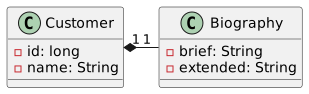
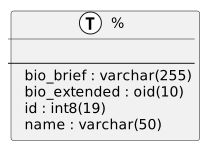
Pour cela JPA propose des annotations spécifiques :
@Embeddable: Cette annotation indique que les membres d’une classe Java peuvent être persistés en tant qu’attributs de la classe qui les utilise. En d’autres termes, elle spécifie qu’une classe peut être utilisée comme composant réutilisable dont les propriétés peuvent être incorporées dans une autre entité.
@Embedded: Utilisée au niveau d’un membre de classe annoté avec @Embeddable, cette annotation indique que le membre annoté doit être intégré dans la relation. Cela signifie que les propriétés de la classe annotée avec @Embeddable seront incluses dans la table de la classe qui les utilise.
@Builder
@NoArgsConstructor(access = AccessLevel.PROTECTED)
@AllArgsConstructor

@Embeddable
public class Biography {
    @Column(name = "BIO_BRIEF")
    private String brief;

    @Lob
    @Column(name = "BIO_EXTENDED")
    private String extended;
}@Getter
@Setter
@ToString
@RequiredArgsConstructor(staticName = "of")
@NoArgsConstructor(access = AccessLevel.PROTECTED)
@Entity
@Table(name = "CUSTOMER", schema = "ex_biography")
public class Customer {
@Id
@GeneratedValue
private long id;
@Column(length = 50, nullable = false)
@NonNull
private String name;
@Embedded
@Column()
private Biography biography;
}Customer.java
On peut donc rendre persistente une instance de Customer associé à une instance de Biography.
Creation et persistence d’un Customer
import fr.univtln.bruno.demos.jpa.hello.samples.ex_biography.Customer;
try (EntityManager entityManager = emf.createEntityManager()) {
   entityManager.getTransaction().begin();

   Customer customer = Customer.of("Jim");
   customer.setBiography(Biography.builder()
      .brief("bla")
      .extended("bla bla")
      .build());
   entityManager.persist(customer);

   entityManager.getTransaction().commit();
}
dans une seule relation
| id | name | bio_brief | bio_extended |
|---|---|---|---|
| 1 | Jim | bla | 16818 |
One to Many (1-N)
@Getter
@Setter
@ToString
@AllArgsConstructor(staticName = "of")
@NoArgsConstructor(access = AccessLevel.PROTECTED)

@Embeddable
@Table(name = "LINE", schema = "EX_ONE_TO_MANY_B")
public class Line {
    @NonNull
    private String product;

    private double price;
}
@Getter
@Setter
@ToString
@NoArgsConstructor
@Builder
@AllArgsConstructor
@Entity
@Table(name = "EORDER", schema = "EX_ONE_TO_MANY_B")
public class Order {
@Id
@GeneratedValue(strategy = GenerationType.SEQUENCE)
private long id;
@Builder.Default
@Column(nullable = false)
private LocalDateTime date = LocalDateTime.now();
@ElementCollection
@CollectionTable(name = "LINE", schema = "EX_ONE_TO_MANY_B")
@Singular
private Set<Line> lines = new HashSet<>();
}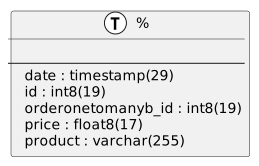
Avec deux entités
Dans le cas général, l’attribut de type Collection<T> est annoté avec @OneToMany.
L’attribut optionnel mappedBy indique le nom de l’attribut correspondant dans le type T si l’on souhaite une relation bi-directionnelle. L’autre entité (de Type T) est alors annotée avace @ManyToOne
@Getter
@Setter
@ToString
@NoArgsConstructor

@Entity
@Table(name = "EORDER", schema = "EX_ONE_TO_MANY_A")
public class Order {
    @Id
    @GeneratedValue(strategy = GenerationType.SEQUENCE)
    private long id;

    private LocalDateTime date = LocalDateTime.now();

    @OneToMany(mappedBy = "order",
            cascade = {CascadeType.PERSIST,
                    CascadeType.REMOVE},
            orphanRemoval = true)
    @ToString.Exclude
    private Set<Line> lines = new HashSet<>();

    public Order addLine(Line line) {
        line.setOrder(this);
        lines.add(line);
        return this;
    }

    public Order removeLine(Line line) {
        line.setOrder(null);
        lines.remove(line);
        return this;
    }
}
@Getter
@Setter
@ToString
@RequiredArgsConstructor(staticName = "of")
@NoArgsConstructor(access = AccessLevel.PROTECTED)
@Entity
@Table(name = "LINE", schema = "EX_ONE_TO_MANY_A")
public class Line {
@Id
@GeneratedValue(strategy = GenerationType.SEQUENCE)
private long id;
@NonNull
private String product;
@NonNull // just for requiredargsconstructor
private double price;
@ManyToOne
@JoinColumn(nullable = false)
@ToString.Exclude
private Order order;
public void setOrder(Order order) {
if (this.order != null) {
this.order.getLines().remove(this);
}
this.order = order;
if (order != null) {
order.getLines().add(this);
}
}
}21:30:45.953 [IJava-executor-0] INFO notebook -- Order(id=1, date=2026-11-01T21:30:45.813350) [Line(id=3, product=Pen, price=1.0), Line(id=2, product=Paper, price=5.0), Line(id=1, product=Scissor, price=8.0)]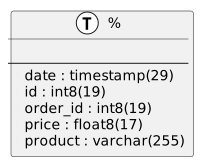
| order_id | order_date | line_id | product | price |
|---|---|---|---|---|
| 1 | 2026-11-01 21:30:45.81335 | 1 | Scissor | 8.0 |
| 1 | 2026-11-01 21:30:45.81335 | 2 | Paper | 5.0 |
| 1 | 2026-11-01 21:30:45.81335 | 3 | Pen | 1.0 |
| 2 | 2026-11-01 21:30:45.823244 | 4 | Car | 20000.0 |
| 2 | 2026-11-01 21:30:45.823244 | 5 | Moto | 8000.0 |
Many to Many (N-M)
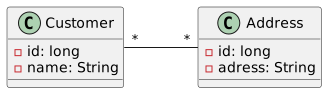
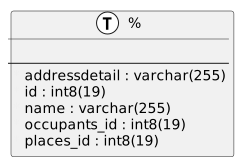
L’annotation @ManyToMany en Java Persistence API (JPA) est utilisée pour modéliser une relation many-to-many entre deux entités. La table d’association sera alors générée et utilisée implicitement.
@Getter
@Setter
@ToString
@RequiredArgsConstructor(staticName = "of")
@NoArgsConstructor(access = AccessLevel.PROTECTED)

@Entity
@Table(name = "CUSTOMER", schema = "EX_MANY_TO_MANY")
public class Customer {
    @Id
    @GeneratedValue
    private long id;

    @NonNull
    private String name;

    @ManyToMany
    @ToString.Exclude
    @JoinTable(schema = "EX_MANY_TO_MANY")
    private Set<Address> places = new HashSet<>();

    public void addPlace(Address address) {
        this.places.add(address);
        address.getOccupants().add(this);
    }

    public void removePlace(Address address) {
        this.places.remove(address);
        address.getOccupants().remove(this);
    }
}
@Getter
@Setter
@ToString
@RequiredArgsConstructor(staticName = "of")
@NoArgsConstructor(access = AccessLevel.PROTECTED)
@Entity
@Table(name = "ADDRESS", schema = "EX_MANY_TO_MANY")
public class Address {
@Id
@GeneratedValue
private long id;
@NonNull
private String addressDetail;
@ManyToMany(mappedBy = "places")
@ToString.Exclude
private Set<Customer> occupants= new HashSet<>();
public void addOccupant(Customer customer) {
this.occupants.add(customer);
customer.getPlaces().add(this);
}
public void removeOccupant(Customer customer) {
this.occupants.remove(customer);
customer.getPlaces().remove(this);
}
}21:30:51.354 [IJava-executor-0] WARN o.a.h.c.p.ResponseProcessCookies -- Invalid cookie header: "set-cookie: __cf_bm=bhnIm1k_9biMZKi_FoWslEBWfWDYzoagVX_7dX9MBgM-1793568651.3216243-1.0.1.1-PjfiZctXOyX_RmLGoh6hm8HrGZmqBZfu_PkfqbQIP8ijv4pWF_5TpPNzJ8FJQAo6Wd1.OH6StYnrIy1jH4j9sogJNOmAMQmARcFuFXB1Noxy_Yj5OJNLV2S9KPR2l6MS; HttpOnly; SameSite=None; Secure; Path=/; Domain=repo.maven.apache.org; Expires=Sun, 01 Nov 2026 22:00:51 GMT". Invalid 'expires' attribute: Sun, 01 Nov 2026 22:00:51 GMT
21:30:51.457 [IJava-executor-0] WARN o.a.h.c.p.ResponseProcessCookies -- Invalid cookie header: "set-cookie: __cf_bm=WQxY1o_bKIHge1ijWlAYjswP0uMx.l26OuiZ4IEb0IQ-1793568651.436449-1.0.1.1-Go_00A1KktlCFx2Va7E0BO71psikE8vH4KBIkDOQFGuH61ZuonOKw6ddtMjuOSolt8b5Fq09aXG0fx0408JlnPIDTYPNXJpaoZiXpvWOSnvyM7D4MkVGVHCmqUG2NNRt; HttpOnly; SameSite=None; Secure; Path=/; Domain=repo.maven.apache.org; Expires=Sun, 01 Nov 2026 22:00:51 GMT". Invalid 'expires' attribute: Sun, 01 Nov 2026 22:00:51 GMT
21:30:51.500 [IJava-executor-0] WARN o.a.h.c.p.ResponseProcessCookies -- Invalid cookie header: "set-cookie: __cf_bm=J1U_3srct1mWJLSMi6J9DoH6yzKwLrAbB4t.eFPlocM-1793568651.4770033-1.0.1.1-3Jgh3J7X2fJPw8PbKkH_cJihe3ZduWvBjy4aQ3ds.3wbP5e2QGnd.wXDfLeLzDVmGZgIiM6V1zSNrKk7YO40Ph_xYspi8CtE2L0gsSNuLeGXwpyjw6tvQxG7V21VDMb1; HttpOnly; SameSite=None; Secure; Path=/; Domain=repo.maven.apache.org; Expires=Sun, 01 Nov 2026 22:00:51 GMT". Invalid 'expires' attribute: Sun, 01 Nov 2026 22:00:51 GMT
21:30:51.541 [IJava-executor-0] WARN o.a.h.c.p.ResponseProcessCookies -- Invalid cookie header: "set-cookie: __cf_bm=Aax3M_EfZYYyIZMfLpvo6wZ_eg2yKTriLTEs68z7720-1793568651.5193458-1.0.1.1-bFJfq1BB5aZzOUCNRhS96GNNiKI64hLX.0YOE0HXuIyZtFuNFFUuNKq4ZFqgOyJCgkBzac8x2GPNHh3F2riHfda1rPb3Gx.n7bSs.Fe.FlOGbf5zlxL66iK2Nhf2sG2f; HttpOnly; SameSite=None; Secure; Path=/; Domain=repo.maven.apache.org; Expires=Sun, 01 Nov 2026 22:00:51 GMT". Invalid 'expires' attribute: Sun, 01 Nov 2026 22:00:51 GMT
21:30:51.587 [BasicRepositoryConnector-repo.maven.apache.org-0-0] WARN o.a.h.c.p.ResponseProcessCookies -- Invalid cookie header: "set-cookie: __cf_bm=vbUVTd0MlNxzLqdiQIBA.q9ZQcydYUy1kr4AKi8C0kY-1793568651.5644107-1.0.1.1-VeoknpPeER7rt_Bi8SFqyYGbBGhdOcJgBctlpNN4ysLoyjo6bGKy3eVFxO6bNH.w68ItAv2_M.VH2An8.dysrO9kQOl9qTOtsRQgcYVo8XyGLo4sNgiCRBobkXZczL.s; HttpOnly; SameSite=None; Secure; Path=/; Domain=repo.maven.apache.org; Expires=Sun, 01 Nov 2026 22:00:51 GMT". Invalid 'expires' attribute: Sun, 01 Nov 2026 22:00:51 GMT
21:30:55.045 [BasicRepositoryConnector-repo.maven.apache.org-0-3] WARN o.a.h.c.p.ResponseProcessCookies -- Invalid cookie header: "set-cookie: __cf_bm=_O8pqnt2NqKTVt_5Re79To5d5wIoHoLmFwfUKv3uKw4-1793568651.6102548-1.0.1.1-aVOVKCAtgHB0W4tFSJ4P4gp91zAZ.ZlCUVol8kVpjtwyUwX6rbGlvlXwDjiViIOsU6jlxVK58NiWulKjzKgbYksviMuEaGBoDBfKJhFyxkA3D4wR9uvLPzq4dtXAxDhp; HttpOnly; SameSite=None; Secure; Path=/; Domain=repo.maven.apache.org; Expires=Sun, 01 Nov 2026 22:00:51 GMT". Invalid 'expires' attribute: Sun, 01 Nov 2026 22:00:51 GMT
21:30:55.058 [BasicRepositoryConnector-repo.maven.apache.org-0-1] WARN o.a.h.c.p.ResponseProcessCookies -- Invalid cookie header: "set-cookie: __cf_bm=YASE_pGWMLWqYvfUO66F0RhwZMZVWhzEue7gf_GyF0Y-1793568655.0364096-1.0.1.1-3P9wOcxTGIzGjIWJrCRM.9FAigu0iB5JGPlJ39Ict4KKNlpN8C9HomIgkwweFRc8kIkj4CFAsQpLbiYusevrrAzF1PBLSLzctVVtN7NrjOmY0VAcyaX_2rNKfZZj3zE0; HttpOnly; SameSite=None; Secure; Path=/; Domain=repo.maven.apache.org; Expires=Sun, 01 Nov 2026 22:00:55 GMT". Invalid 'expires' attribute: Sun, 01 Nov 2026 22:00:55 GMT
21:30:55.078 [BasicRepositoryConnector-repo.maven.apache.org-0-2] WARN o.a.h.c.p.ResponseProcessCookies -- Invalid cookie header: "set-cookie: __cf_bm=uMFKdBq9fgnTnFctxgrq0mYByKg8nJDA6kW1T_hU3Vc-1793568651.613071-1.0.1.1-Sdjs.lfFxAPjOxelJR4_yNmH3pfu72MttUnF1carn0a40n_iMGHMYzaTRuBC9XCDAm_erEExHqTdMelcE8UWVw7B2xEOK4miMR_r7Y7VEDM_pZtcHEOz1dqrC5hYQK2Y; HttpOnly; SameSite=None; Secure; Path=/; Domain=repo.maven.apache.org; Expires=Sun, 01 Nov 2026 22:00:51 GMT". Invalid 'expires' attribute: Sun, 01 Nov 2026 22:00:51 GMT| id | name |
|---|---|
| 2 | Dr. Keshia Sporer |
| 3 | Laureen Bahringer |
| 4 | Donita Mills |
| 5 | Erwin Hermiston |
| 6 | Mr. Darcel Schroeder |
| occupants_id | places_id |
|---|---|
| 2 | 1 |
| 3 | 1 |
| 4 | 1 |
| 5 | 1 |
| 6 | 1 |
| 2 | 2 |
| 4 | 2 |
| 5 | 2 |
| 6 | 2 |
| id | addressdetail |
|---|---|
| 1 | 104 Robbie Mill, New Ralphburgh, IA 69778 |
| 2 | 3165 Edgardo Loaf, South Felton, CA 55876 |